If you are building your wedding day timeline right now, chances are you have a spot labeled “Flatlay Details and Getting Ready Photos” with a number next to each part. Ten minutes. Fifteen minutes. It looks reasonable on paper. It is an easy number to land on, especially if this is your first time building a timeline and no one has walked you through what actually happens during that window.
That is exactly what I want to do here. Not to point out what is wrong with your timeline, but to give you the real numbers so you can build one that holds up on the day, without any surprises.
This comes up in almost every planning call I have, so let us go through it properly.
Flatlay Details: Why Your Photo and Video Team Need More Time Than You May Think
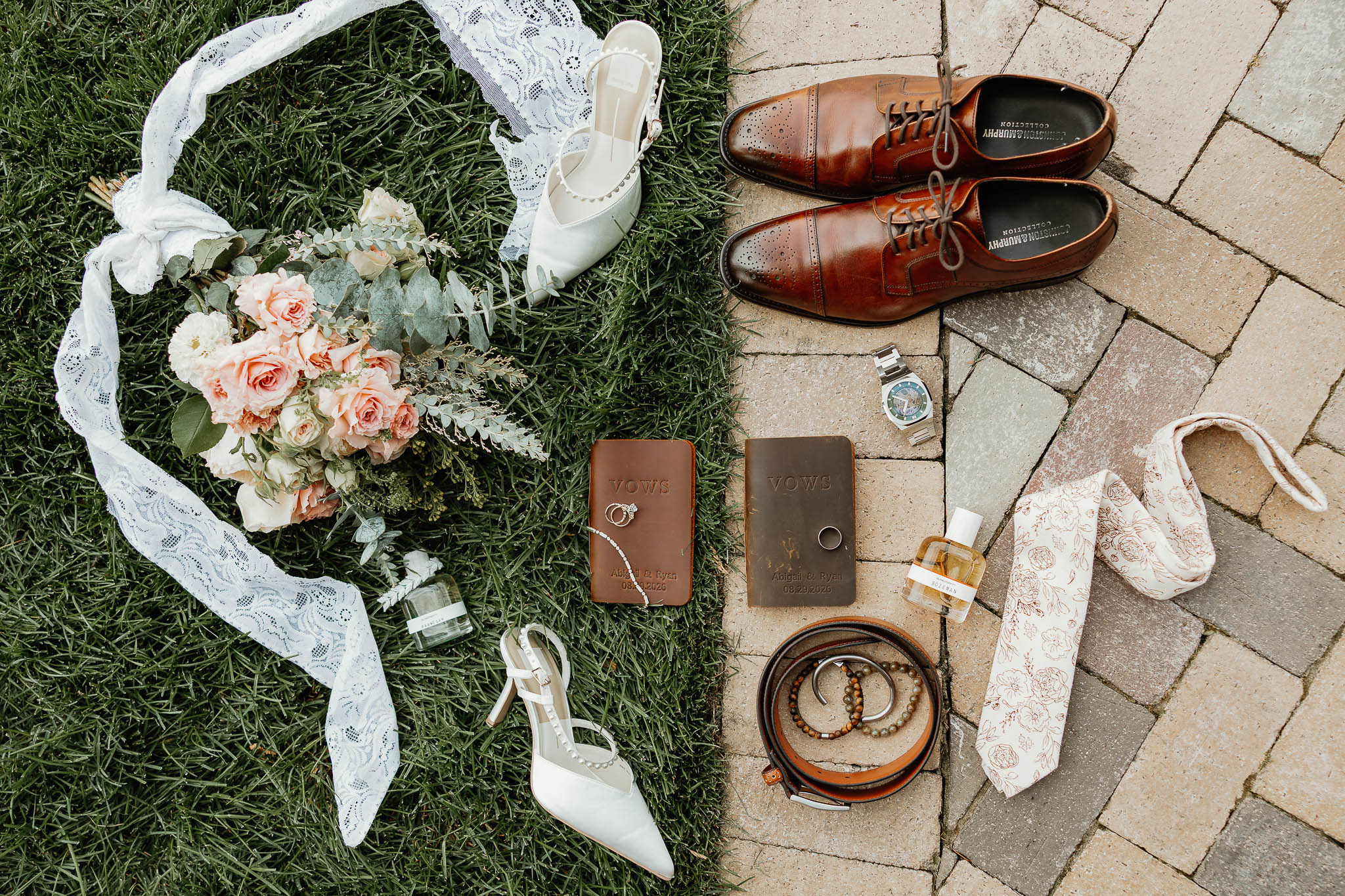
Here is what people picture when they hear ‘flatlays’ or ‘wedding details’: the rings get set on a table, a quick click, done in ten minutes.
Here is what actually goes into it.
What goes into a flatlay:
- Gathering everything: rings, invitation suite, shoes, perfume, jewelry, a bouquet, sometimes a family heirloom that matters more than any of it
- Finding good natural light in the room, or figuring out how to create it
- Arranging and re-arranging the pieces until it actually looks right together
- Trying it a few different ways, since these are often the very first thing you see when you open your album
That whole process takes a real 30 minutes, start to finish. It is not about working slowly. It is about how many small, often sentimental items are involved, and how much they deserve a little care instead of a rushed pass.
Here is the honest version: ten minutes is enough time to set the rings next to the invitation, but not much beyond that. Unless everything is already gathered and sitting in one place beforehand, there simply is not enough time to lay it out, find the light, and get it looking the way it deserves to look. If you want that full, thoughtful result, thirty minutes is what it actually takes.
Quick tip: if your timeline is tight, gather your flatlay items the night before and set them in one spot. It will not shrink that thirty minutes by much, but it does mean less of it goes toward hunting for a missing shoe.


Final Touches: 30 Minutes Per Person


“Final touches” sounds like a small window. It is not. For each person getting photographed, whether that is the bride, the groom, or two brides, or two grooms, a full 30 minutes is what it actually takes to cover the last stretch of getting ready well. That includes:
- Zipping the dress or buttoning the shirt
- Putting in earrings or fastening cufflinks
- The final mirror check
- Handing over the bouquet or pinning the boutonniere
- The candid moments with a parent or best friend standing nearby
Fifteen minutes does not hold all of that. In practice, fifteen minutes usually means choosing between the dress zip and the earrings, or the boutonniere and the mirror moment. You should not have to lose any of those simply because the timeline only budgeted enough time for half of a getting ready.
And this applies to both partners equally. If you are two brides or two grooms, each person gets their own 30 minutes. There is no version of this where one partner’s final touches are the “quick one.”

Full Getting Ready Coverage: Plan for 1.5 to 2 Hours
If you want what I call the “From Start to Finish” version of the getting ready story, not just the final few minutes before you walk out the door, build in 1.5 to 2 hours. That extra time is what makes room for the parts you cannot really plan for or predict: the nervous energy in the room, the hair and makeup team at work, friends helping with buttons, the quiet moment right before things get busy. Those unplanned, in-between moments consistently turn into some of the most emotional images in the whole gallery, and they simply cannot happen inside a rushed 20 minute window squeezed between hair and makeup wrapping up and the ceremony starting.
This is also exactly why a second photographer makes such a difference for full “From Start to Finish” coverage. If both partners are getting ready at the same time, in different locations, one photographer physically cannot be in two places at once. A second photographer means both getting ready stories actually get told, instead of one partner’s morning being cut short so the other one gets covered. If you are still deciding whether a second photographer makes sense for your day, I broke down the Pros and Cons of Having a Second Photographer at Your Wedding in more detail.


A Quick Reference for Your Timeline
Flatlay details (setup and shoot)
Full getting ready coverage
Final touches, per person
Why This Matters for Your Wedding Day Timeline
None of this is about padding your schedule for the sake of it. It comes down to something pretty simple: I do not have superhuman powers.
I cannot bend time or clone myself. Being in two places at once is not possible, unless a second photographer is involved. I cannot turn a rushed ten minutes into a styled flatlay through sheer will and caffeine. These numbers are not me being extra, and they are not pulled out of thin air either. They come from shooting nearly 200 weddings. I have learned, over and over, exactly how much time this job takes. It takes a real human being, with two hands and one camera, to do this well.
When you sit down to build your day-of timeline, give flatlays their real 30 minutes. Give each person their real 30 minutes of final touches. If the “From Start to Finish” version matters to you, protect that 1.5 to 2 hours. You will not remember, years from now, that the timeline felt tight. You will just look back at a gallery that feels unhurried, because it was, and because I was actually given enough time to be human about it.
Frequently Asked Questions
Can flatlay setup happen before final touches start?
Yes, and this is one of the easiest ways to save time. I always recommend building a box labeled “details” ahead of time. Fill it with rings, invitations, and other detail items. Have it ready for me on the wedding day. This way, flatlays can often happen while hair and makeup finish up. That means no extra time added on top of everything else.
What if our timeline genuinely cannot fit 1.5 to 2 hours for getting ready?
Full getting ready coverage is a recommendation, not a requirement. If your morning is tight, prioritize final touches and flatlays first. Give 30 minutes to final touches per person. Give 30 minutes to flatlays. Treat anything beyond that as a bonus, not a must-have.
Does this timing change for elopements or smaller weddings?
The flatlay and final touches minimums stay about the same. The actual steps involved do not change based on guest count. What usually shrinks is the earlier, more relaxed getting ready window, simply because there are fewer people and less happening in the room.
Do I need a second photographer for full getting ready coverage?
Depends. Are you getting ready in separate locations? Do you want the full “From Start to Finish” story for both people? One photographer can only be in one place at a time. A second photographer is what allows both getting ready mornings to be told in full instead of one being shortened. Need a breakdown of when it makes sense and when it does not? Take a look at my post: The Pros and Cons of Having a Second Photographer at Your Wedding.
KEY TAKEAWAYS
- Flatlay details alone take approximately 30 minutes, not just the quick ten minutes often assumed.
- Each person’s final touches also require 30 minutes to ensure nothing gets rushed or overlooked.
- Plan for 1.5 to 2 hours for full getting ready coverage to capture candid moments and emotions.
- Consider a second photographer, especially if both partners get ready separately, to fully document the event.
- Properly allocating time for flatlay details and getting ready photos enhances the overall wedding timeline.
